1. Introduction: The Trap of Shiny Tools
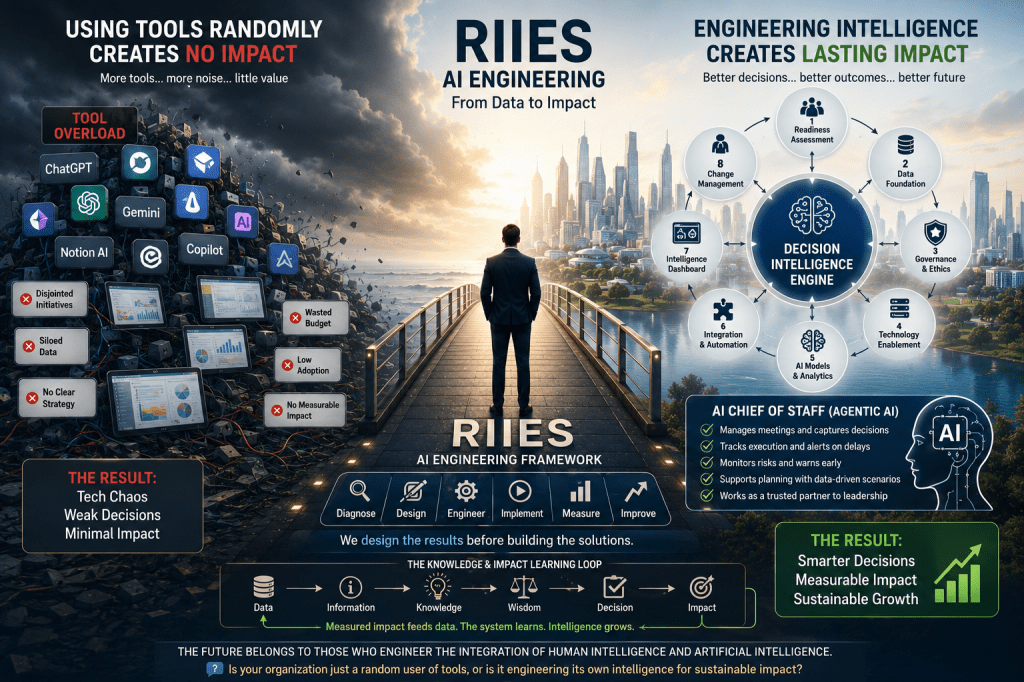
Most organizations today are rushing into a frantic race to acquire the latest artificial intelligence technologies. They accumulate applications and stack digital tools in what can only be described as “software warehouses,” only to later face a harsh reality: enormous technological noise with no tangible institutional impact.
Falling into the trap of the “shiny tool” is the first obstacle to real transformation. An intelligent organization is not built by collecting tools, but by re-engineering its decision-making system.
The major gap between the current reality and reaching the fifth level of digital maturity, the transformational level, lies in leadership mindset. Technology alone does not create change unless it becomes part of an integrated institutional architecture aimed at transforming the obsession with technology into an “engineering of impact.”
2. First Lesson: Value Lies in the Decision, Not in the Number of Applications
The common belief that the smartest organization is the one that owns the largest number of AI applications is limited and misleading. The strategic truth introduced by the RIIES system is that artificial intelligence is only a means, while improving the quality of decisions is the ultimate goal.
Value is not created in software interfaces, but in the decision room, where the eight components of the system, from readiness assessment to the Decision Intelligence Engine, are employed to ensure that every bit of data serves the organization’s goals.
“The value of artificial intelligence is not measured by the number of tools an organization owns, but by the quality of the decisions it makes and the impact it creates.”
3. Second Lesson: The Equation of Integrated Intelligence — Human + Machine
The RIIES system is built on the philosophy of Integrated Intelligence, an equation that rejects the idea of replacing humans and instead seeks to amplify human capabilities. In this ecosystem, artificial intelligence does not operate as an isolated island, but as a strategic partner integrated within a governed institutional context.
This equation is achieved through the integration of four essential elements:
Human expertise, which provides context, wisdom, and ethical values.
Data, which serves as the raw material refined into knowledge.
Artificial intelligence, which acts as a driving force for speed, predictive analysis, and the generation of alternatives.
Governance, which provides the framework that ensures privacy, fairness, and accountability.
4. Third Lesson: Developing the Knowledge Pyramid — The Impact Learning Loop
The RIIES system introduces a major evolution in the classical DIKW pyramid: Data, Information, Knowledge, and Wisdom. While the traditional model stops at wisdom, RIIES adds two decisive steps that turn knowledge into an active force: decision and impact.
This transition from wisdom to measured impact is the true essence of an intelligent organization.
More importantly, RIIES is not a linear model; it is a circular system. Measured impact returns to feed the data foundation again in a continuous learning loop. An organization that adopts this approach learns from its own actions and uses the impact of its previous decisions to improve its future inputs. This ensures cumulative growth and evolving intelligence.
5. Fourth Lesson: Why “Engineering” and Not Just “Experimentation”?
Stacking tools without an architectural model is spending without value. The choice of the word “Engineering” in the RIIES system is a declaration of a disciplined methodology that moves away from randomness.
Engineering means committing to the six-stage lifecycle defined by the system:
Diagnose → Design → Engineer → Implement → Measure → Improve
This cycle ensures that transformation is built on the system’s eight components, such as the data foundation, governance and ethics, and the intelligence dashboard.
We do not experiment with tools and wait for results by chance. We design the results before we begin building the solutions.
“Engineering means that we design transformation before we build it. We do not test tools and hope for results.”
6. Fifth Lesson: The AI Chief of Staff — Agentic AI
The concept of the Reasonix Chief of Staff AI represents the applied peak of Agentic AI. Here, we are not talking about a simple chatbot that answers questions, but about a system of intelligent agents that work as partners to senior management within clear boundaries and under full human supervision, through a human-in-the-loop model.
This agent performs strategic and complex tasks, including:
Meeting management: summarizing outcomes and extracting decisions immediately.
Execution follow-up: tracking decisions made and automatically alerting leaders when progress is delayed.
Risk management: early detection of operational and financial risks and alerting leadership before a crisis occurs.
Planning support: preparing strategic scenarios by connecting indicators from multiple sources.
7. Conclusion: Beyond Technology
The final message of the RIIES system is that the future does not belong to those who own more technology, but to those who succeed in engineering the integration between human intelligence and artificial intelligence.
The ultimate goal is to move the organization toward the level of Integrated Intelligence, where the system becomes capable of sustainable adaptation and self-learning.
Real transformation begins when we understand that true value is created through the way data is connected to decisions, and decisions are connected to impact.
A question for leaders:
“Is your organization today merely a random user of tools, or has it truly begun engineering its own intelligence to achieve sustainable institutional impact?”


Leave a Reply