One of the most important developments in artificial intelligence is the connection between Reasoning AI and Agentic AI.
Reasoning AI gives artificial intelligence the ability to analyze, compare, plan, and solve complex problems. Agentic AI gives artificial intelligence the ability to act, use tools, follow workflows, and complete tasks. When these two capabilities come together, we move from simple AI assistants to intelligent systems that can think, plan, and execute.
In simple terms:
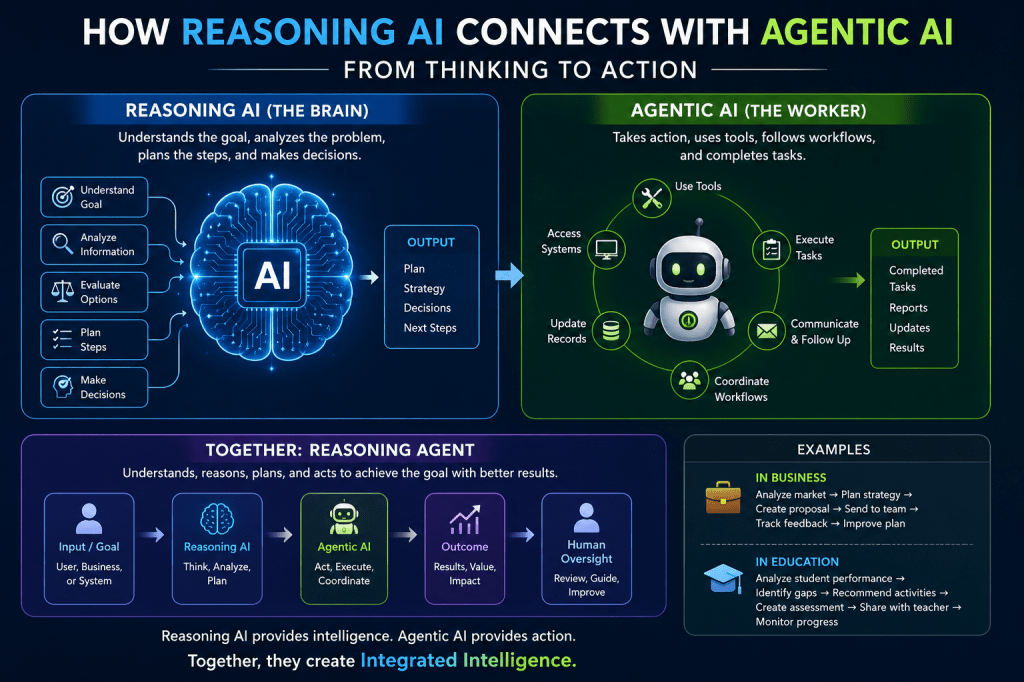
Reasoning AI is the brain. Agentic AI is the worker.
A reasoning model can understand the goal, break it into steps, identify risks, compare options, and decide what should happen next. An agentic system can then use tools, access systems, search data, prepare documents, send reminders, update records, or coordinate with other agents.
This combination is powerful because many real-world problems are not solved by one answer. They require a sequence of decisions and actions.
For example, in a business setting, a company may ask AI to prepare a market expansion plan. A normal chatbot may generate a general answer. A reasoning agent can do much more. It can analyze the market, compare competitors, identify customer segments, evaluate risks, prepare a strategy, generate a financial outline, create a presentation, and recommend next steps for the leadership team.
In education, the same connection is even more important. A teacher may ask AI to support a struggling student. A simple AI tool may suggest general activities. A reasoning agent can analyze the student’s performance, identify learning gaps, connect them with curriculum objectives, recommend differentiated activities, generate a short assessment, and prepare a progress note for the teacher or parent.
This is why the future is not just about AI agents. The future is about reasoning agents.
A reasoning agent does not only complete a task. It understands why the task matters, what constraints exist, what information is missing, what risks should be considered, and what quality standards should be applied.
For organizations, this means AI can become more than automation. It can become a decision-support and execution layer inside daily operations. Instead of only asking AI to “write,” “summarize,” or “translate,” teams will ask AI to plan, evaluate, coordinate, improve, and follow up.
However, this also creates a need for strong governance. When AI can reason and act, organizations must define clear permissions, approval points, ethical limits, data access rules, and human supervision. The more capable the agent becomes, the more important accountability becomes.
At Reasonix, this connection fits strongly with the concept of Integrated Intelligence. Human experts provide purpose, ethics, context, creativity, and judgment. Reasoning AI provides analysis, planning, and structured thinking. Agentic AI provides execution, coordination, and automation.
Together, they create a new model of work:
Human Intelligence + Reasoning AI + Agentic AI = Integrated Intelligence
This is the foundation for the next generation of intelligent education systems, business solutions, and digital transformation platforms.
 Reasonix™
Leave a comment