rtificial Intelligence has become remarkably good at generating content, answering questions, analyzing information, and automating tasks. Yet beneath every meaningful decision lies a capability that is often overlooked:
Reasoning.
Reasoning is the ability to analyze information, identify relationships, evaluate alternatives, draw conclusions, and make decisions based on evidence and logic. It is the process that transforms information into understanding and understanding into action.
Without reasoning, intelligence becomes little more than information retrieval.
With reasoning, intelligence becomes a tool for solving complex problems, making sound judgments, and creating new knowledge.
What Is Reasoning?
Reasoning is the mental process through which conclusions are reached from available information.
It allows humans—and increasingly intelligent systems—to move beyond facts and answer deeper questions such as:
- What does this information mean?
- Why did this happen?
- What is likely to happen next?
- Which option is best?
- What evidence supports this conclusion?
Reasoning bridges the gap between knowledge and decision-making.
It is not merely knowing; it is understanding.
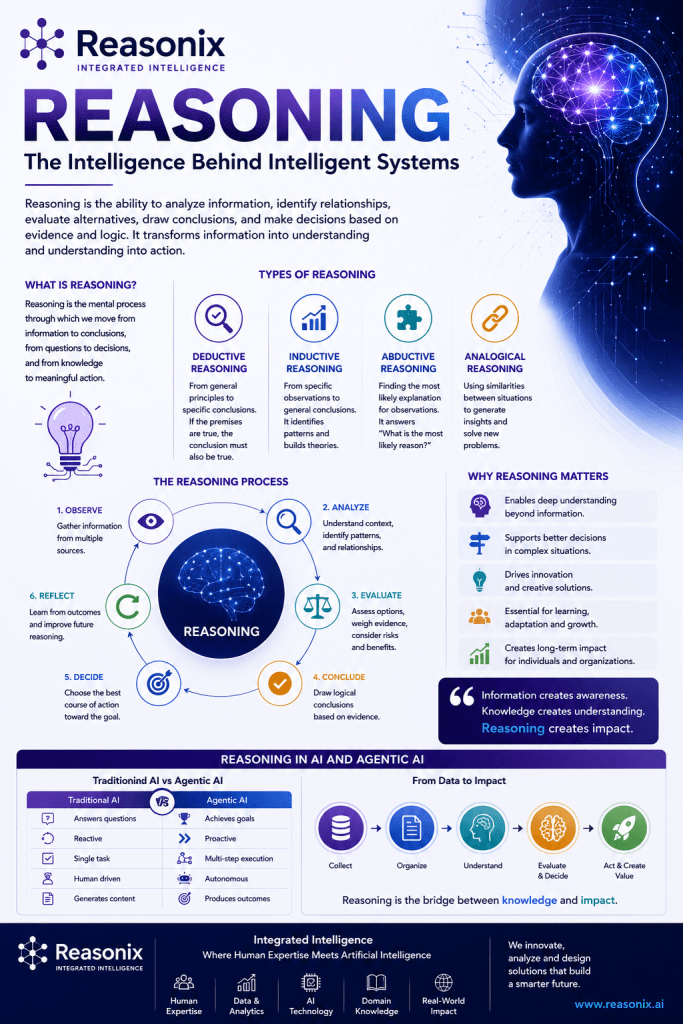
Types of Reasoning
Deductive Reasoning
Deductive reasoning begins with general principles and applies them to specific situations.
Example:
- All metals conduct electricity.
- Copper is a metal.
- Therefore, copper conducts electricity.
If the premises are true, the conclusion must also be true.
Deductive reasoning is the foundation of mathematics, engineering, and formal logic.
Inductive Reasoning
Inductive reasoning works in the opposite direction.
It begins with observations and develops broader conclusions.
Example:
- The sun has risen every day in recorded history.
- Therefore, the sun will likely rise tomorrow.
Inductive reasoning drives scientific discovery because it allows us to identify patterns and formulate theories.
Abductive Reasoning
Abductive reasoning seeks the most likely explanation for available evidence.
Example:
- The ground is wet.
- The most likely explanation is that it rained.
This form of reasoning is frequently used in medicine, diagnostics, investigation, and strategic decision-making.
Analogical Reasoning
Analogical reasoning uses similarities between situations to generate insights.
Humans frequently use analogies to solve new problems based on prior experiences.
Innovation often emerges from the ability to recognize patterns across seemingly unrelated domains.
Reasoning and Human Intelligence
Many educational systems emphasize memorization.
However, the future belongs to individuals who can reason.
Information is now available instantly through digital technologies and AI systems. What differentiates high performers is not how much they know, but how effectively they can:
- Analyze information
- Evaluate evidence
- Solve problems
- Make decisions
- Adapt to new situations
Reasoning enables critical thinking, creativity, innovation, and leadership.
It is one of the most valuable competencies in the modern world.
Reasoning in Artificial Intelligence
Modern AI systems have achieved impressive capabilities in language generation and pattern recognition. However, the next frontier of AI is reasoning.
Reasoning allows AI systems to:
- Break complex problems into smaller steps
- Evaluate alternative solutions
- Plan actions
- Detect inconsistencies
- Make informed decisions
- Adapt to changing environments
This capability is central to the development of Agentic AI and autonomous systems.
The evolution of AI can be viewed as a progression:
Data → Information → Knowledge → Reasoning → Decisions → Action
Organizations that focus only on data often struggle.
Organizations that develop reasoning capabilities gain strategic advantages.
Reasoning as the Foundation of Agentic AI
Agentic AI represents a significant shift in artificial intelligence.
Traditional AI systems respond to requests.
Agentic AI systems pursue objectives.
To accomplish this, they require reasoning capabilities that enable them to:
- Understand goals
- Create plans
- Evaluate outcomes
- Adjust strategies
- Coordinate actions
Without reasoning, an AI system can generate answers.
With reasoning, it can pursue outcomes.
This distinction will define the next generation of intelligent systems.
Reasoning and Integrated Intelligence
At Reasonix, we view reasoning as a central component of Integrated Intelligence.
Artificial intelligence provides computational power, data processing, and pattern recognition.
Human intelligence contributes judgment, ethics, context, creativity, and wisdom.
Reasoning is the bridge that connects these capabilities.
It transforms information into insight and insight into meaningful action.
True intelligence emerges not from information alone, but from the ability to reason effectively about that information.
Building a Reasoning-Centered Future
The future of education, business, and technology will increasingly depend on reasoning.
Educational systems must move beyond memorization toward analysis, inquiry, and problem-solving.
Organizations must cultivate reasoning-driven cultures that value evidence, critical thinking, and informed decision-making.
AI systems must evolve from content generators into reasoning partners capable of supporting complex human challenges.
The most important question of the next decade may not be:
“How much information do we have?”
But rather:
“How effectively can we reason with it?”
Because information creates awareness.
Knowledge creates understanding.
Reasoning creates impact.
-reasonix


Leave a Reply