Artificial Intelligence is no longer a future concept reserved for technology companies. Today, AI is becoming a practical business tool that helps organizations work faster, make better decisions, reduce costs, and create smarter customer experiences. From small startups to large enterprises, businesses are beginning to understand that AI is not only about machines replacing tasks; it is about building more intelligent, adaptive, and competitive organizations.
One of the most important benefits of AI in business is automation. Many companies still spend a large amount of time on repetitive tasks such as data entry, report generation, customer support, scheduling, inventory tracking, and document processing. AI can handle these tasks with speed and accuracy, allowing employees to focus on higher-value work such as strategy, creativity, problem-solving, and relationship building. This shift does not remove the importance of people; rather, it allows human talent to be used more effectively.
AI also improves decision-making. Businesses generate huge amounts of data every day, but data alone is not valuable unless it can be understood and used. AI systems can analyze patterns, detect risks, forecast demand, identify customer behavior, and provide insights that help leaders make informed decisions. Instead of relying only on intuition or past experience, companies can use AI to support decisions with evidence and predictive intelligence.
Customer experience is another major area where AI is transforming business. Chatbots, recommendation systems, personalized offers, smart search tools, and automated support platforms allow companies to respond to customers faster and more personally. When used correctly, AI can help businesses understand what customers need, predict what they may want next, and provide services that feel more relevant and efficient.
In marketing and sales, AI is helping companies move from general campaigns to personalized engagement. AI can analyze customer segments, measure campaign performance, write content drafts, recommend the best time to contact clients, and identify potential leads. This gives businesses the ability to reach the right audience with the right message at the right time.
AI is also changing operations and productivity. In supply chains, AI can forecast shortages, optimize delivery routes, and improve inventory management. In finance, it can detect unusual transactions, support budgeting, and improve reporting. In human resources, it can assist with recruitment, employee training, and performance analysis. Across departments, AI acts as a powerful assistant that strengthens efficiency and accuracy.
However, adopting AI in business is not only a technical decision. It is also a strategic and cultural transformation. Companies need clear goals, quality data, trained employees, ethical policies, and leadership support. AI should not be implemented just because it is trendy. It should solve real business problems, improve measurable outcomes, and align with the organization’s mission.
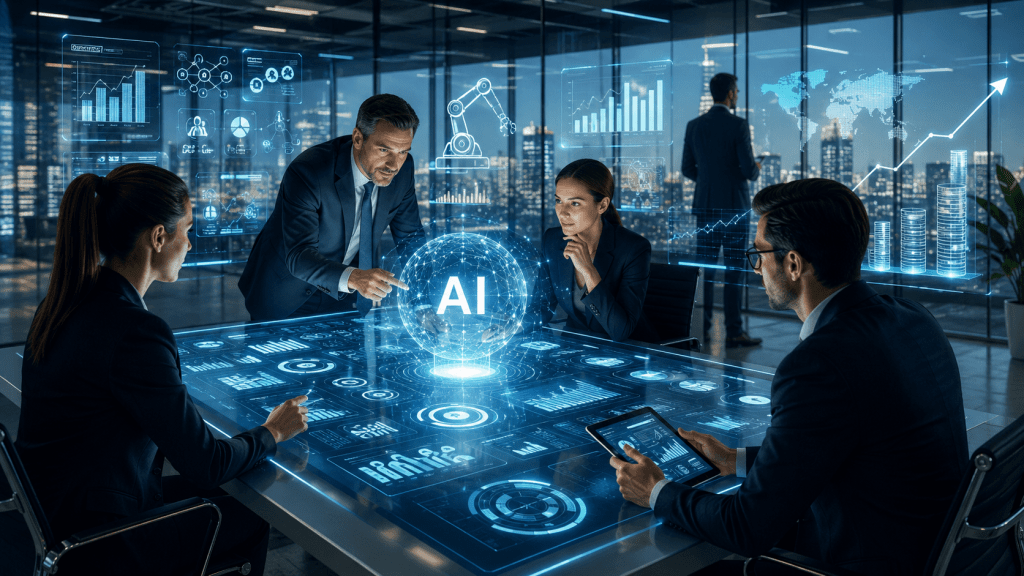
Another important point is that AI works best when combined with human intelligence. Machines are excellent at speed, scale, pattern recognition, and automation. Humans bring judgment, ethics, creativity, empathy, and contextual understanding. The future of business is not artificial intelligence replacing people, but integrated intelligence: humans and AI working together to achieve better results.
For companies that want to begin their AI journey, the first step is to identify areas where AI can create immediate value. This may include automating repetitive tasks, improving customer service, analyzing business data, or developing smarter internal systems. Starting small, measuring impact, and gradually expanding AI adoption is often more effective than trying to transform everything at once.
In conclusion, AI is becoming a core driver of business transformation. It helps organizations become faster, smarter, and more responsive to change. Businesses that adopt AI strategically will be better prepared for the future, while those that ignore it may struggle to compete in a rapidly evolving digital economy. The real opportunity is not just to use AI as a tool, but to build a new kind of intelligent organization where technology and human expertise work together for sustainable growth.
 Reasonix™
Leave a comment