AI Agents: The Next Step Beyond Chatbots
Artificial intelligence is moving from simple conversation to real action. For years, people interacted with AI mainly through chatbots: we asked questions, received answers, and used the information ourselves. Today, a new generation of systems is emerging: AI agents.
An AI agent is not only a tool that responds. It is a system that can understand a goal, plan steps, use tools, make decisions, execute tasks, and improve through feedback. This shift is important because it changes AI from a passive assistant into an active digital worker.
What Is an AI Agent?
An AI agent is a software system powered by artificial intelligence that can perform tasks with a certain level of autonomy. Instead of waiting for every small instruction, it can analyze the objective, break it into smaller actions, choose the right tools, and complete the work.
For example, a normal chatbot may answer:
“Here are five ideas for your marketing campaign.”
But an AI agent can go further. It may create the campaign plan, prepare content, schedule posts, analyze engagement, and suggest improvements. This is the main difference: chatbots answer; agents act.
The Main Components of an AI Agent
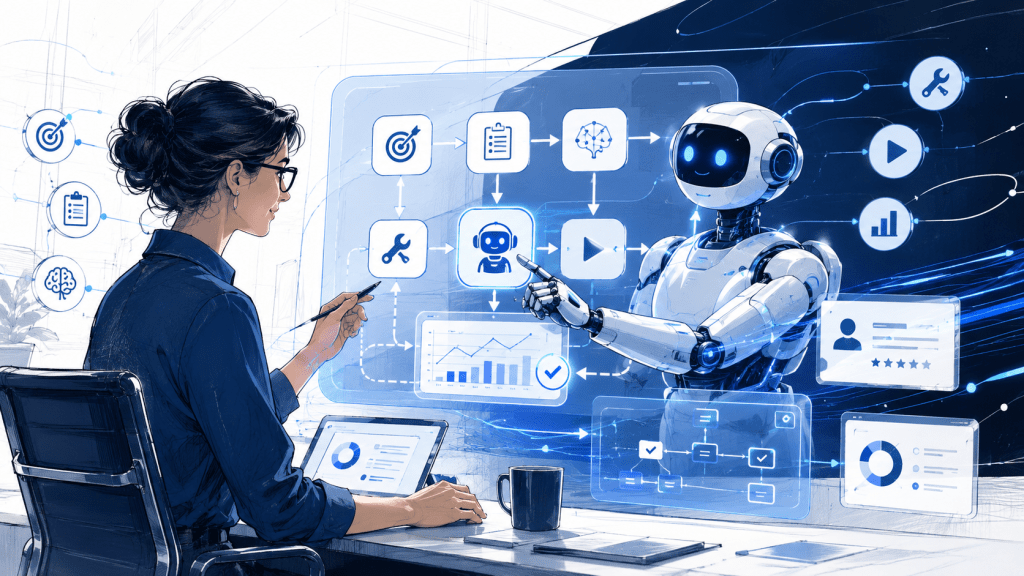
A strong AI agent usually includes several key components.
First, it needs a goal. The agent must know what it is trying to achieve. This could be writing a report, managing customer requests, organizing data, planning a project, or supporting decision-making.
Second, it needs reasoning and planning. The agent should be able to divide a large task into smaller steps. This allows it to move from an idea to a structured workflow.
Third, it needs tools. AI agents can connect with email, calendars, databases, websites, documents, dashboards, APIs, and business systems. These tools allow the agent to take real actions, not just produce text.
Fourth, it needs memory and context. A useful agent should remember previous instructions, user preferences, organizational knowledge, and project history. Without context, the agent becomes limited and repetitive.
Finally, it needs feedback and control. Human supervision remains essential. The best AI agents are not designed to replace people completely, but to work with them intelligently and safely.
Why AI Agents Matter
AI agents matter because organizations are overwhelmed with repetitive digital work. Many teams spend hours every day writing emails, preparing summaries, organizing files, following up on tasks, creating reports, and searching for information.
AI agents can reduce this burden. They can help employees focus on higher-value work such as strategy, creativity, communication, leadership, and problem-solving.
In companies, AI agents can support customer service, sales, operations, project management, research, finance, human resources, and executive decision-making. In education, they can support teachers, personalize learning, analyze student progress, and design learning activities. In government, they can improve service delivery, automate citizen support, and simplify administrative procedures.
Examples of AI Agents
A research agent can search, summarize, compare sources, and prepare a structured briefing.
A customer service agent can answer common questions, open support tickets, classify issues, and escalate complex cases to humans.
A project management agent can track tasks, remind team members, summarize progress, and identify delays.
A data analysis agent can collect data, clean it, generate charts, and explain insights.
An executive assistant agent can manage schedules, prepare meeting notes, draft emails, and organize decisions.
These examples show that AI agents are not one product. They are a new way of designing intelligent systems around goals and workflows.
The Role of Humans
The future of AI agents should not be based on replacing humans. It should be based on integrated intelligence: combining human judgment with machine capability.
Humans bring values, ethics, empathy, experience, creativity, and strategic thinking. AI agents bring speed, automation, consistency, analysis, and scalability. When both work together, organizations can become more productive and more intelligent.
However, human oversight is necessary. AI agents should operate within clear limits. They should be transparent, secure, and aligned with the organization’s goals. Sensitive decisions should remain under human control.
Challenges and Risks
AI agents also bring challenges. If they are poorly designed, they may make wrong decisions, use incorrect information, or take actions without enough supervision. They may also create privacy and security concerns if they access sensitive data.
Organizations need clear policies before using AI agents. They should define what the agent can do, what it cannot do, who supervises it, how data is protected, and how mistakes are corrected.
The most successful organizations will not be those that simply use AI agents quickly. They will be those that use them wisely.
The Future of AI Agents
AI agents are likely to become part of everyday work. In the future, every organization may have a network of specialized agents: one for communication, one for research, one for planning, one for customer support, one for data, and one for decision support.
These agents will work together like a digital team. They will not just answer questions; they will help organizations think, plan, act, and improve.
The real power of AI agents is not automation alone. It is the ability to create a smarter relationship between humans, machines, and work.
Conclusion
AI agents represent a major step in the evolution of artificial intelligence. They move AI from conversation to action, from answering to executing, and from isolated tools to intelligent workflows.
For businesses, schools, governments, and startups, AI agents offer a new opportunity to improve productivity, innovation, and service quality. But their success depends on responsible design, human direction, and clear purpose.
The future will not belong only to artificial intelligence. It will belong to those who know how to combine AI agents with human intelligence to create meaningful impact.


Leave a Reply