Artificial Intelligence has evolved rapidly over the past decade. We have moved from simple automation tools to intelligent assistants capable of generating content, analyzing data, and supporting decision-making. Today, a new generation of AI is emerging—Agentic AI.
Agentic AI represents one of the most significant shifts in the history of artificial intelligence. Instead of merely responding to user prompts, AI agents can understand goals, plan actions, make decisions, use tools, collaborate with other systems, and execute complex tasks autonomously.
For organizations, Agentic AI is not simply another technology trend—it is a transformative capability that can redefine productivity, decision-making, innovation, and operational efficiency.
What Is Agentic AI?
Agentic AI refers to intelligent systems that operate as autonomous agents capable of:
- Understanding objectives
- Planning multi-step actions
- Making decisions
- Using software tools and external systems
- Learning from feedback
- Executing tasks with minimal human intervention
Unlike traditional AI systems that wait for instructions, Agentic AI actively works toward achieving goals.
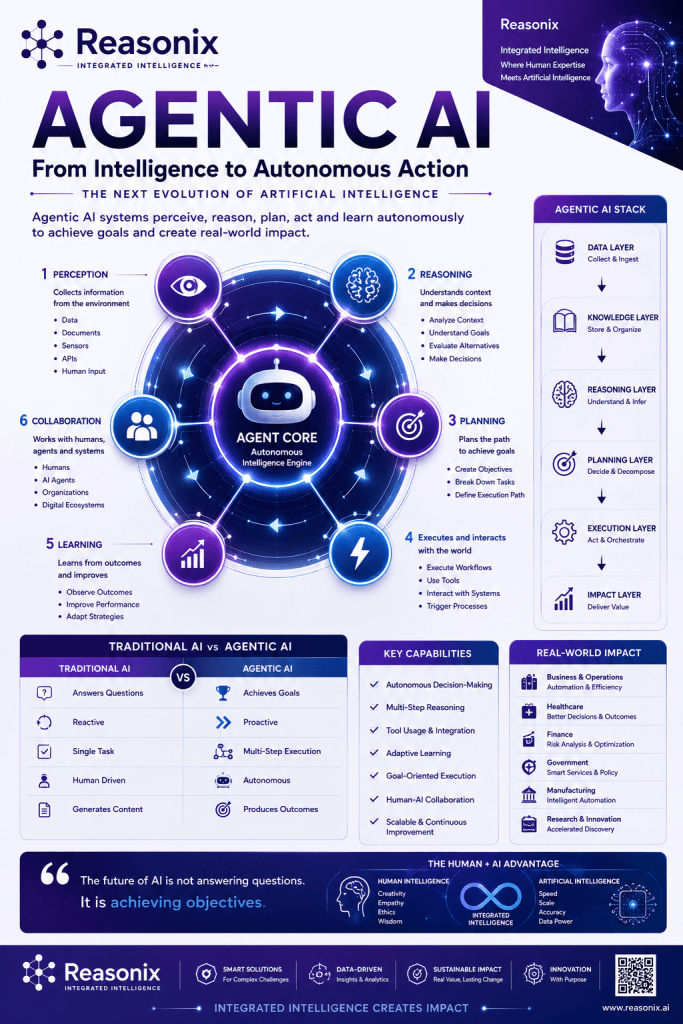
Traditional AI vs Agentic AI
| Traditional AI | Agentic AI |
|---|---|
| Answers questions | Achieves goals |
| Reacts to prompts | Proactively plans actions |
| Single interaction | Multi-step workflows |
| Limited context | Long-term reasoning |
| Human performs actions | Agent performs actions |
For example:
Traditional AI:
“Write an email inviting participants to a workshop.”
Agentic AI:
“Organize the workshop, identify participants, prepare invitations, schedule follow-ups, track registrations, and generate attendance reports.”
Core Capabilities of Agentic AI
1. Goal-Oriented Reasoning
Agentic systems focus on outcomes rather than instructions.
Instead of asking:
“What should I do next?”
The agent asks:
“What actions are required to achieve the goal?”
2. Planning and Execution
AI agents can break complex tasks into smaller tasks.
Example:
Goal: Launch a new training program.
The agent may:
- Analyze market demand
- Identify target audience
- Create marketing content
- Build landing pages
- Schedule campaigns
- Track performance
- Generate reports
3. Tool Usage
Modern agents can use:
- Email systems
- CRM platforms
- ERP systems
- Databases
- Search engines
- Calendars
- Productivity tools
They act like digital employees interacting with business systems.
4. Memory and Context
Agentic AI can remember:
- Previous interactions
- Organizational goals
- User preferences
- Historical decisions
This creates continuity and intelligent decision-making.
5. Multi-Agent Collaboration
Organizations can deploy multiple specialized agents:
- HR Agent
- Marketing Agent
- Finance Agent
- Training Agent
- Customer Service Agent
These agents collaborate to achieve larger organizational goals.
Why Agentic AI Matters
The world is entering an era where organizations are overwhelmed by:
- Data
- Complexity
- Speed of change
- Resource limitations
Traditional software helps people work faster.
Agentic AI helps organizations work smarter.
The next competitive advantage will not come from having more employees or more software—it will come from having intelligent agents working alongside human teams.
Benefits of Agentic AI for Organizations
1. Increased Productivity
Agents can handle repetitive tasks continuously.
Examples:
- Report generation
- Data analysis
- Scheduling
- Documentation
- Monitoring
Employees can focus on strategic and creative work.
2. Better Decision-Making
AI agents can analyze thousands of data points and provide recommendations in seconds.
This enables:
- Faster decisions
- More accurate forecasts
- Risk identification
- Opportunity detection
3. Cost Reduction
Organizations can automate workflows that previously required significant human effort.
Benefits include:
- Reduced operational costs
- Improved efficiency
- Lower administrative burden
4. 24/7 Operations
Unlike human teams, agents can operate continuously.
This is particularly valuable for:
- Customer support
- Monitoring systems
- Global operations
- Real-time analytics
5. Scalability
Organizations can scale operations without proportional increases in staffing.
One intelligent agent can perform the work of multiple manual processes simultaneously.
Agentic AI Applications Across Industries
Education
Agentic AI can:
- Build personalized learning paths
- Analyze student performance
- Generate assessments
- Support teachers
- Recommend interventions
Business and Enterprise
AI agents can:
- Monitor KPIs
- Generate executive reports
- Analyze market trends
- Support strategic planning
- Manage workflows
Healthcare
Applications include:
- Patient monitoring
- Clinical decision support
- Treatment recommendations
- Administrative automation
Government
Agents can support:
- Citizen services
- Policy analysis
- Resource allocation
- Digital transformation
Human Resources
AI agents can:
- Screen candidates
- Schedule interviews
- Manage onboarding
- Track performance development
The Rise of the AI Workforce
Many experts believe organizations will soon operate with a hybrid workforce consisting of:
Human Workforce
Responsible for:
- Leadership
- Creativity
- Ethics
- Relationships
- Strategic vision
AI Workforce
Responsible for:
- Data processing
- Monitoring
- Automation
- Analysis
- Execution
The most successful organizations will be those that effectively integrate both.
This concept aligns strongly with the philosophy of Integrated Intelligence—the integration of human expertise and artificial intelligence within a unified ecosystem.
Challenges and Risks
While Agentic AI offers enormous opportunities, organizations must address several challenges:
Governance
Agents need clear boundaries and permissions.
Security
Access to sensitive systems must be carefully controlled.
Transparency
Organizations must understand how agents make decisions.
Human Oversight
Humans should remain accountable for critical decisions.
Ethical Considerations
Organizations must ensure fairness, privacy, and responsible use.
How Organizations Should Prepare
1. Assess AI Readiness
Evaluate:
- Data quality
- Digital infrastructure
- Organizational culture
- Leadership commitment
2. Start with High-Impact Use Cases
Examples:
- Customer support
- Internal knowledge management
- Reporting automation
- Training support
3. Build Internal AI Capability
Invest in:
- AI literacy
- Prompt engineering
- Agent design
- Data governance
4. Develop an Agentic AI Strategy
Organizations need a roadmap that addresses:
- Objectives
- Governance
- Security
- Integration
- Scalability
5. Create Human-AI Collaboration Models
The goal is not replacing people.
The goal is augmenting human capabilities.
Conclusion
Agentic AI is not merely the next generation of artificial intelligence—it is the beginning of a new operating model for organizations.
The future will belong to institutions that successfully combine:
- Human expertise
- Data intelligence
- Autonomous AI agents
- Continuous learning
Organizations that embrace Agentic AI today will be better positioned to innovate, adapt, and lead tomorrow.
The question is no longer whether organizations will use AI agents. The real question is how quickly they can build the capabilities to work alongside them and unlock their full potential.
-reasonix integrated intelligence
 Reasonix™