The New Educational Framework for Building Future Innovators
Introduction: Preparing Students for an Intelligent Future

The world is moving toward a future shaped by artificial intelligence, robotics, automation, and advanced digital technologies. In this rapidly changing environment, education must evolve from simply delivering knowledge to developing the ability to think, create, and innovate.
The question facing educators today is not only:
“What should students learn?”
but rather:
“How can we prepare students to solve problems that do not yet exist?”
The answer lies in developing a new generation of learners who possess strong analytical thinking, creativity, and technological fluency.
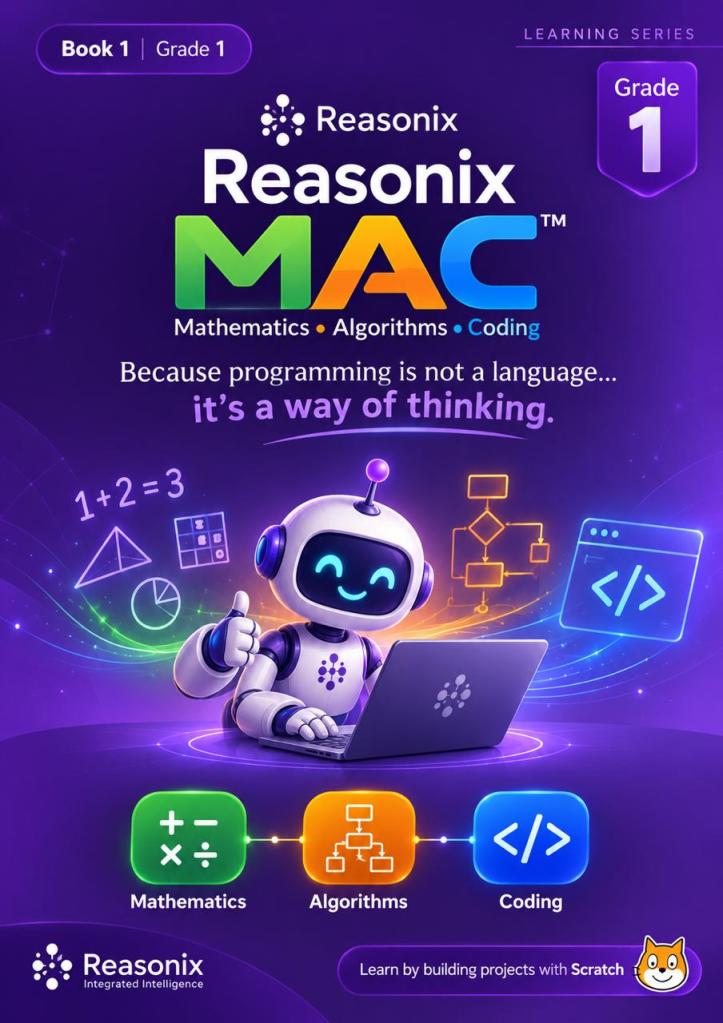
This is the vision behind MAC™ — Mathematics • Algorithms • Coding, an integrated educational program designed to develop computational intelligence by connecting three essential domains:
MAC™ introduces a new approach to STEM education, where students do not only learn technology — they learn how to create the future.Why Do We Need a New Approach to STEM Education?
For many years, mathematics, computer science, and programming have been taught as separate subjects. Students learn mathematical concepts in one classroom, programming skills in another, and technology applications somewhere else.
However, the most important innovations of our time emerge from the integration of these disciplines.
Artificial intelligence depends on mathematics.
Robotics depends on algorithms.
Digital innovation depends on coding.
A student who wants to design an AI system must understand data and mathematical models. A student who wants to build a robot must understand logic, algorithms, and programming. A student who wants to solve global challenges must combine knowledge from multiple fields.
Therefore, the future of education requires moving from isolated subjects toward integrated intelligence development.What is MAC™?
MAC™ (Mathematics • Algorithms • Coding) is a comprehensive learning framework that develops students’ computational intelligence through a progressive educational journey.
The program transforms students from:
Technology Users → Technology Creators
Instead of learning programming as a technical skill only, students learn how to:
MAC™ combines mathematical reasoning, computational thinking, and coding practice into one ecosystem.The Three Pillars of MAC™1. Mathematics: The Language of Intelligence
Mathematics is not only about numbers and formulas; it is a way of understanding the world.
Through MAC™, students discover mathematics as a tool for:
Students explore how mathematics powers modern technologies such as:
For example, the same mathematical concepts used in school can help students understand how AI predicts information, how robots move, and how engineers design intelligent systems.
Mathematics becomes meaningful when students see its connection to real-world innovation.2. Algorithms: The Science of Problem Solving
Before a computer can solve a problem, humans must first design the thinking process behind the solution.
This is the role of algorithms.
An algorithm is a structured sequence of steps that transforms a problem into a solution.
Through MAC™, students develop algorithmic thinking by learning:
Students learn that every successful technology begins with a powerful algorithm.
From search engines to recommendation systems and autonomous vehicles, algorithms are the invisible engines behind modern innovation.3. Coding: Turning Ideas into Reality
Coding is the creative language that allows students to transform their ideas into real solutions.
In MAC™, coding is not taught through memorizing commands. Instead, students use programming as a tool for exploration, creativity, and innovation.
The learning journey progresses from:Foundation Coding
Students learn:
Applied Coding
Students develop:
Advanced Coding
Students explore:
The goal is not to create programmers only; the goal is to create innovators who can use coding to solve problems.The MAC™ Learning Journey
MAC™ follows a progressive pathway designed according to students’ cognitive development.Level 1: Digital Thinkers
Ages 6–8
Students develop:
Learning experiences include:
Level 2: Computational Explorers
Ages 9–11
Students begin connecting mathematics with technology.
They learn:
Projects include:
Level 3: Innovation Builders
Ages 12–14
Students move into advanced computational skills.
They explore:
Projects include:
Level 4: Future Engineers
Ages 15–18
Students develop advanced innovation capabilities.
They explore:
Students become capable of designing solutions for real-world challenges.The MAC™ Learning Philosophy
MAC™ follows a simple but powerful learning cycle:Learn → Create → Solve → InnovateLearn
Students understand concepts and principles.Create
Students apply knowledge through building projects.Solve
Students use their skills to address authentic challenges.Innovate
Students develop original ideas and solutions.
This approach changes learning from memorization into creation.Real-World Learning Through Projects
The strongest learning happens when students apply knowledge to meaningful challenges.
Examples of MAC™ projects include:AI Projects
Students create intelligent systems using data and algorithms.Robotics Projects
Students combine mathematics, electronics, and coding to build autonomous machines.Smart Technology Projects
Students design IoT solutions connecting the physical and digital worlds.Engineering Simulations
Students use mathematical models to understand real systems.
Through these projects, students experience the complete innovation process.Measuring Future Skills
Traditional education often measures what students remember.
MAC™ measures what students can create.
Students are evaluated across multiple areas:
This creates a complete profile of each learner’s computational intelligence.The Impact of MAC™
MAC™ prepares students for a future where technology is integrated into every aspect of life.
Students completing the program will be able to:
✓ Think critically
✓ Solve complex problems
✓ Understand artificial intelligence
✓ Create digital solutions
✓ Develop innovative projects
✓ Pursue future STEM careersConclusion: Building the Minds That Will Shape Tomorrow
The future will not belong only to those who know how to use technology. It will belong to those who understand it, create it, and improve it.
MAC™ represents a new educational vision where mathematics becomes a tool for discovery, algorithms become a method of thinking, and coding becomes a language of innovation.
By integrating Mathematics • Algorithms • Coding, we can develop a generation of learners who are not only prepared for the future — but capable of designing it.
MAC™: Building Computational Intelligence for the Next Generation.
LikeLike


Leave a Reply